
Orlando Julius: A Masterclass in Musical Architecture and Arrangement
Music critic, singer and student of the art of music, Osezua Stephen-Imobhio revisits a classic track by Nigerian Afrobeat and Highlife pioneer Orlando Julius. “Ẹniyàn l’ó k’éṣin l'óró” was released in 2006 on the album Longevity and Reclamation.
Osezua Stephen-Imobhio
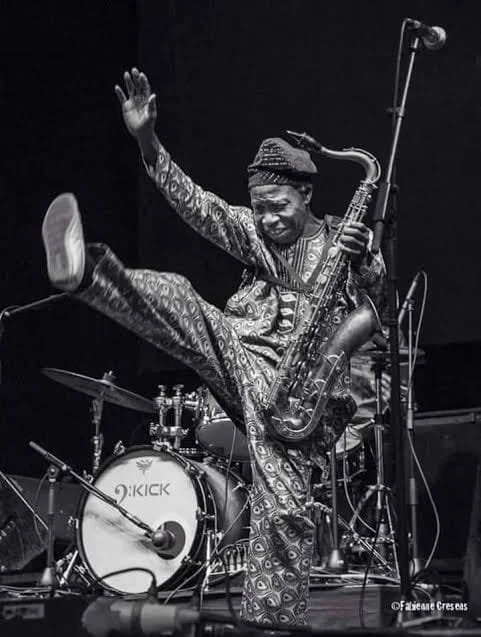
U.S. Orlando Julius performing on stage. Image courtesy of writer.
I would like to revisit Orlando Julius’s “Ẹniyàn l’ó k’éṣin l'óró” from a purely musical and technical perspective, examining what makes his style distinctive and his musicianship exceptional.
Beyond the lyrical message, this composition reveals Orlando Julius as a consummate musician and a master of horn arrangement. His ability to construct intricate, delicate yet tightly interlocking horn lines, while maintaining a seamless relationship between the music and the philosophical depth of the lyrics, demonstrates an extraordinary understanding of musical architecture.
What particularly fascinates me is the interplay between the horns, strings and percussion. Each instrumental section has a clearly defined role, yet none operates in isolation. The horns complement and respond to the vocals, the strings enrich the harmonic texture, and the percussion provides the rhythmic foundation upon which the entire arrangement rests. Together, they create a cohesive musical tapestry in which melody, harmony, rhythm and lyrical expression reinforce one another.
The brilliance of the horn arrangement lies not merely in its complexity, but in its precision, balance and restraint. The horns do not simply embellish the composition; they engage in a carefully structured musical dialogue with the vocals and other instruments. Their phrasing, timing and interlocking patterns contribute to the song’s emotional depth without overwhelming its central message. This is arrangement as a deliberate artistic statement, not just instrumental decoration.
Herein lies the genius of Orlando Julius. He understood that great music transcends a compelling melody, a danceable rhythm or intellectually stimulating lyrics. Its enduring power often lies in how these elements are conceived, developed and integrated into a unified musical expression. The distinction between writing meaningful lyrics and arranging music to give those lyrics their fullest expressive power is particularly important here. One concerns what is being communicated; the other concerns how the entire musical ensemble gives that message its sonic identity and emotional force.
As a music critic, singer and student of the art of music, I regard this as a hallmark of complete musicianship: the ability to combine lyrical intelligence with a sophisticated command of harmony, orchestration, instrumental arrangement and rhythmic interplay.
Orlando Julius was, indeed, a master of his craft—a complete musician whose genius extended far beyond the microphone. His artistry reminds us that to appreciate a great composition fully, we must listen not only to what the singer says, but also to what the instruments say, how they interact, and how the entire arrangement transforms a lyrical idea into a compelling musical experience.
Osezua Stephen-Imobhio is a music critic, singer and student of the art of music based in Nigeria.
For more stories told from an African perspective, follow us at africarelatedinc
SHARE THIS STORY