
U.S. Efforts to Prevent and Combat Transnational Sextortion of Children
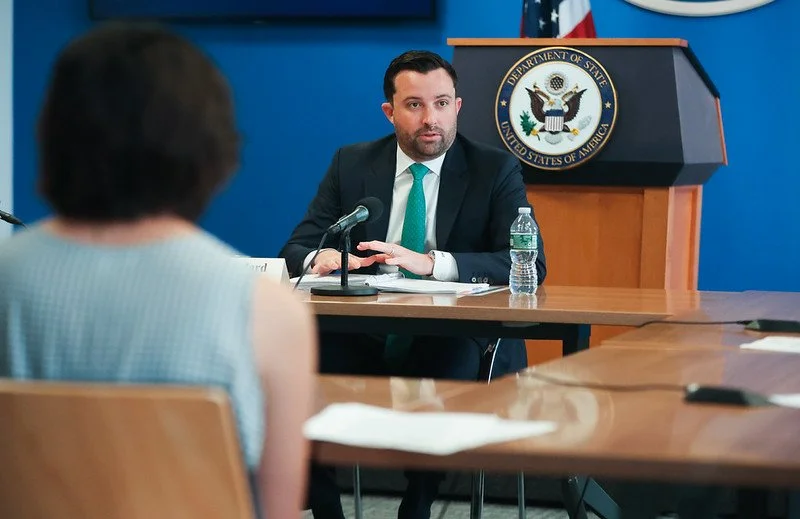
Deputy Assistant Secretary of State David Bedard of the Bureau of International Narcotics and Law Enforcement Affairs (INL) led a roundtable discussion on a U.S.-sponsored resolution recently adopted and commits member states to a series of enforcement actions to disrupt criminal networks and hold perpetrators of transnational child sextortion accountable.
Oyiza Adaba - Africa-Related, New York
U.S. DEPARTMENT of STATE
Office of the Spokesperson
BRIEFING
NEW YORK CITY
BRIEFER: DAVID BEDARD, DEPUTY ASSISTANT SECRETARY
BUREAU OF INTERNATIONAL NARCOTICS AND LAW ENFORCEMENT AFFAIRS
Deputy Assistant Secretary of State David Bedard of the Bureau of International Narcotics and Law Enforcement Affairs (INL) led a roundtable discussion on a U.S.-sponsored resolution recently adopted by the Commission on Crime Prevention and Criminal Justice (CCPCJ). The resolution commits member states to a series of enforcement actions to disrupt criminal networks and hold perpetrators of transnational child sextortion accountable. During the roundtable, Deputy Assistant Secretary Bedard highlighted ongoing U.S. efforts to rally international action against sextortion networks targeting American children.
This event took place on the sidelines of a broader series of engagements in New York City from July 15–16. Deputy Assistant Secretary Bedard also met with key partners, including the United Nations Office on Drugs and Crime (UNODC) and the Tim Tebow Foundation, to strengthen collaborative efforts against child exploitation.
Transcript
Thank you all for being here. My name is David Bedard. I am Deputy Assistant Secretary at the Department of State in our Bureau of International Narcotics and Law Enforcement Affairs, which is quite a mouthful, cover our offices of Europe, Asia, and our international negotiations team. The international negotiations team is the one that was in Vienna that worked on this resolution that I am talking about today.
So INL – I’ll use that for brevity here – is the department’s counter-crime arm. So we keep Americans safe by countering crime and illegal drugs abroad through security assistance, diplomatic pressure, visa restrictions, and rewards programs. I’m in New York today and came yesterday for a conference on combating child exploitation, which was hosted by the Tim Tebow Foundation in coordination with the Canadian Centre for Child Protection and the U.S. Mission to the United Nations.
As governments and entities from outside the public sector gathered to discuss child exploitation, I wanted to highlight one of the most urgent and fastest growing threats to children worldwide, which is transnational sextortion.
So let me explain exactly what sextortion is. It’s one of the things that the resolution was able to accomplish, give this a definition. So sextortion is the use of explicit images as leverage for blackmail and is not a new crime. What is new is the rapid rise of financially motivated transnational form that specifically targets children. In just a few years, it has exploded in scale and lethality.
So here’s how it works. An offender creates a fake online identity, so often posing as a young woman on social media or a gaming platform or any other number of sites, and targets a teenage boy. After quickly gaining the child’s trust, the offender persuades him to share an explicit image; the offender threatens to send that image to his friends, to his family, to his school, to his community unless he pays that offender. The psychological pressure is instant and crushing. In documented cases, children have died by suicide within hours of contact – hours, not days.
Since 2021, more than 40 American teenagers have died by suicide after being sextorted, and reporting from partners abroad suggest the global toll is significantly higher. Thousands more have been victimized, and the threat is growing because organized criminal networks have discovered that this crime is profitable, scalable, and sadly, largely consequence-free.
But these are not always large, hierarchical criminal organizations perpetrating this horrific crime. That’s precisely what makes this so hard and so dangerous. Many of these schemes are run by small, loosely affiliated groups, where they share their scripts and their tactics online for anyone to use. Nigerian authorities have the themselves publicly acknowledged the so-called “Yahoo Boys” phenomenon.
The cumulative effect is industrial in scale: So thousands of children targeted simultaneously across dozens of countries by hundreds of independent actors, all running the same playbook. You don’t always need to be a part of an organized crime group to participate in this. These criminals also use artificial intelligence. They generate deep fakes of children; they exploit social media, gaming platforms, and crypto-messaging apps to reach victims across borders. Wherever in the world they can find a victim, they will exploit that. They launder their proceeds through cryptocurrency, and they operate from countries where, correctly in too many cases, no one will come after them.
So nearly half of all sextortion schemes targeting Americans originate in just two countries – Nigeria and Cote d’Ivoire. In 2025 alone, the National Center for Missing and Exploited Children, NCMEC – their cyber tip line received over 50,000 reports of sextortion. Those are not estimates; those are actual reported cases referred to law enforcement. And the danger does not just stop at sextortion. This crime can be a gateway to child sex trafficking, predators using the same grooming techniques to build relationships with youths and using sextortion as a recruitment tool.
But here’s the core problem, right? These criminals operate across borders by design. In many cases, the only way to bring a perpetrator to justice is to ensure that the country where he lives or she lives is willing and able to prosecute him locally. That requires countries have the right laws, the right investigative skills, the ability to obtain digital evidence, and the institutional will, the political will, to cooperate. Right now, too many countries have gaps in any or all of those areas.
The United States is doing something about it. So this past June at the UN Commission on Crime Prevention and Criminal Justice, the CCPCJ, in Vienna, the United States secured adoption of the first ever resolution specifically dedicated to preventing and combating transnational sextortion of children. So let me explain what the CCPCJ is and why this matters.
The CCPCJ is the UN’s premier annual counter-crime policy forum, where countries adopt resolutions, draft formal consensus-based commitments that put every country on record. So when a resolution passes, it signals to the world that this is a problem worth prioritizing and that countries have agreed to act. This resolution was a first of its kind. We secured it by consensus, meaning every country in the room agreed that this was an issue and that they made commitments to combating it.
So this resolution accomplishes four critical things. First, it defines the problem. For the first time, the world has a shared understanding of this form of sextortion, including how offenders use online platforms to target across borders, how organized criminal groups have industrialized this crime, and the devasting harm they cause, including self-harm and suicide of its children.
Second, it demands action. The resolution calls on countries to strengthen laws, dismantle criminal networks, cut off offenders’ finances, and cooperate across borders. When we say cooperate, we mean concrete things like sharing evidence, responding to law enforcement requests in a timely manner – that’s critical – ensuring that digital evidence obtained from platforms can actually be used in a foreign courtroom. These sounds like technical details, but they’re the difference between a perpetrator walking free and a family getting justice. So every country is now on the record, and there’s no excuse for inaction.
Third, it promotes cooperation with the private sector, right? It calls on social media platforms, gaming companies, messaging services, financial institutions to adopt safety-by-design standards, improve reporting to law enforcement, and help identify victims. These platforms that profit from the connectivity enabling these crimes must be part of the solution.
And fourth, it recognizes victims. It calls for counseling, legal remedies, support services for child victims and their families, and it ensures that children manipulated into committing offenses are treated as victims and not as criminals.
But we’re under no illusions, right? This resolution alone will not stop every predator or save every child. It establishes text accepted by international consensus that we – and you as members of the foreign press – can use to hold to account any country, ours included, that falls short of these commitments. It keeps this on the global agenda and sends an unambiguous message to criminal networks: The world is watching and countries are committed to stopping you.
We’ve already seen what cooperation can achieve. Ivoirian authorities have arrested 18 individuals, convicting nine thus far. Sentences have run up to 10 years. Several of these were cases directly tied to the suicides of American teenagers. That is the model, but we need much, much more of it.
This work is backed by the full authority of the United States Government. In March, President Trump signed the Executive Order on Combating Cybercrime, Fraud, and Predatory Schemes Against American Citizens. This directs prioritization of prosecutions against cyber-enabled fraud, including sextortion schemes targeting American families.
We’re not acting alone, right? We’re not acting without direction. This is a whole-of-government approach. As an immediate next step, we are going to work with the UN to track the implementation of this resolution, combined with direct diplomatic engagement through U.S. embassies worldwide. Where we find gaps, we’ll press for action through dialogue and through pressure.
The United States doesn’t have time, and we will not wait, and we will relent. We’ll bring the full weight of American power to bear against these criminal actors and networks. The State Department will look to sanctions, visa restrictions. Our Justice and law enforcement colleagues will look at prosecutions and extraditions. We’re going to use every tool at our disposal till these networks are dismantled, their leaders are behind bars, and our children are safe.
The families of the children – the families of the children we have lost are not just watching, right? They’re demanding answers. They deserve to see every government fight with urgency and purpose. Right now, it’s simply too easy for these predators to evade detection and to move on to the next victim, and that ends now.
So thank you for your efforts to increase the public awareness of this critical sextortion threat. We know we cannot prosecute our way out of this. The goal is to make this crime harder to commit, faster to detect, and more likely to result in consequences for every perpetrator in every country.
But the resolution is titled Prevent and Combat, so we know we must do more than just law enforcement. We need governments investing in awareness and education and tools that stop a child from becoming a victim in the first place. We’re looking to protect children and deter and arrest the criminals.
Secretary of State Marco Rubio’s Statement
On July 23, 2026, U.S. Secretary of State Marco Rubio released the below statement on New Visa Restriction Policy to Deter and Dismantle Cyberscams and Sextortion
As President Trump made clear in E.O. 14390 on Combatting Cybercrime, Fraud, and Predatory Schemes Against American Citizens, his administration is taking action to counter an unprecedented threat from online investment scams. Often orchestrated by Chinese transnational criminal organizations, scammers have defrauded U.S. citizens of at least $10 billion in 2024 alone while fueling corruption, money laundering, and human trafficking. American children also have been specifically targeted by offenders operating overseas for sextortion scams, devastating families and futures.
Today, I am announcing a new global visa restriction policy under Section 212(a)(3)(C) of the Immigration and Nationality Act. This policy targets individuals responsible for, or complicit in, cybercrime and cyber-enabled crime, such as those involved in cyberscams, and sextortion. Immediate family members of individuals engaged in such illicit activities may also be subjected to visa restrictions.
The Trump Administration is deploying every tool at our disposal—sanctions, prosecutions, asset seizures, extradition requests, and international law enforcement cooperation—to dismantle criminal scam networks and impose costs on those who enable them. By restricting visa issuance to those who are responsible for or complicit in these criminal enterprises, we are sending a clear message: The United States will go after those who prey on our citizens.
SHARE THIS STORY