ABUJA IS CUTTING DOWN ITS FUTURE - AND NO ONE SEEMS TO CARE
Patrick O. Okigbo III - Abuja, Nigeria
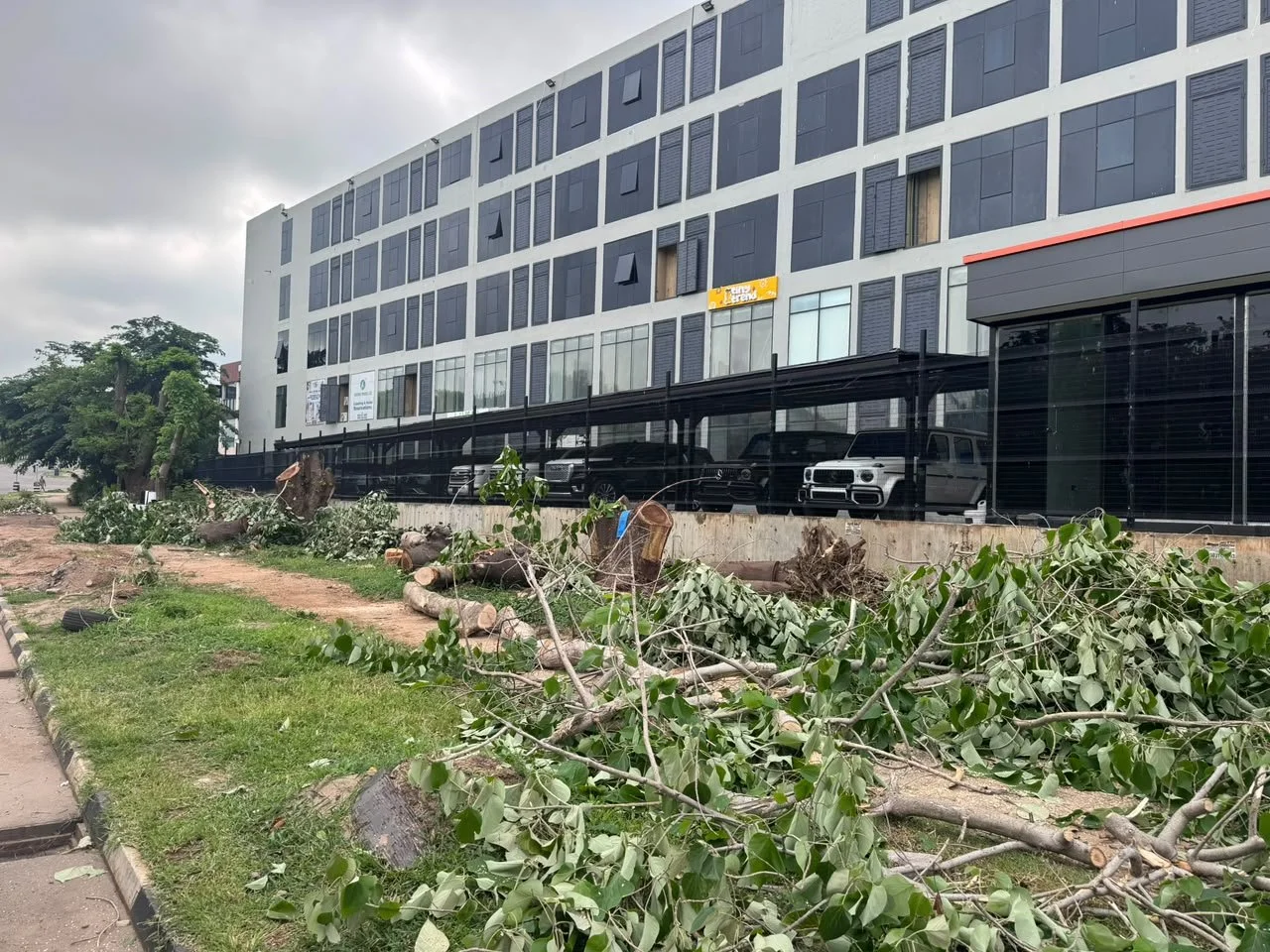
Image of trees felled in Abuja. Photo by Patrick Okigbo III
There are many reasons I fell in love with Abuja. One of them was its trees. Those trees are now disappearing.
After years in Lagos, where the air often felt as though it clasped its fingers around one’s windpipe, Abuja offered something altogether different. Its broad boulevards and generous sidewalks invited long morning walks. Later, when my wife and I took up cycling, those tree-lined avenues became part of our daily ritual. The freshness of the air was almost intoxicating.
The trees were more than landscaping. They gave the city identity. They softened its scale. They reminded you that Abuja had been imagined, not merely built—that someone had once tried to create a capital equal to Nigeria’s ambitions. I missed Lagos’s restaurants and bars, but Abuja’s serenity more than compensated.
Those trees are now disappearing.
Not because they have reached the end of their lives. Not because of disease. Municipal crews have been cutting them down in a methodical sweep, trunk by trunk, removing canopies that took decades to mature. I cannot say with certainty why this is happening. There is no public explanation. From what I can see, many are being sacrificed to make room for solar-powered street lights.
The loss feels larger than the trees themselves.
Abuja was conceived as a corrective to Lagos—a capital that would embody order instead of improvisation, foresight instead of congestion, aspiration instead of accumulation. Its boulevards were part of that vision. To remove mature trees without apparent hesitation suggests that somewhere along the way we have forgotten that a city’s greatest assets are not always the ones we have just built.
I do not blame the men operating the chainsaws, nor even those who signed the work orders. I doubt they act out of malice. If anything, the careful way the felled trunks are gathered suggests an appreciation of their commercial value.
The problem is deeper than bad intentions. It is a failure of imagination.
Development is not simply the accumulation of infrastructure. It is the stewardship of inheritance. Every generation receives assets it did not create and holds them in trust for those yet unborn. A mature tree is one of those assets. It cannot be replaced by a sapling any more than a century can be replaced by a promise.
Perhaps that is what saddens me most.
Within a generation, we have travelled from a society capable of imagining Abuja—a city designed to embody the future we believed Nigeria deserved—to one that no longer instinctively understands why mature trees matter. That distance cannot be measured in kilometres or years. It is measured in felled trunks.
A city is not improved every time something new is added. Sometimes progress lies in knowing what must not be removed.
This post, by itself, changes nothing. A tweet is not activism, and lament is not policy. But perhaps someone in or near my network can place this note before Minister Nyesom Wike.
I hope he receives it in the spirit in which it is is written. Many residents appreciate the investment his administration has made in Abuja’s roads, interchanges, and street lighting. Those improvements matter.
But so do the trees.
The choice was never meant to be between light and shade. A truly modern capital should know how to preserve both.
Because a hundred years from now, no one will remember who installed today’s street lights. But they will know whether we had the wisdom to leave them a city worth walking through.
Patrick O. Okigbo III is the Founder of Nextier, a public policy advisory firm and think-tank, focused on improving governance and development outcomes in Africa.
For more stories told from an African perspective, follow us at africarelatedinc
SHARE THIS STORY