
Should a state of emergency be declared in Nigeria?
By melody-Esther soyemi - Africa-Related, Nigeria
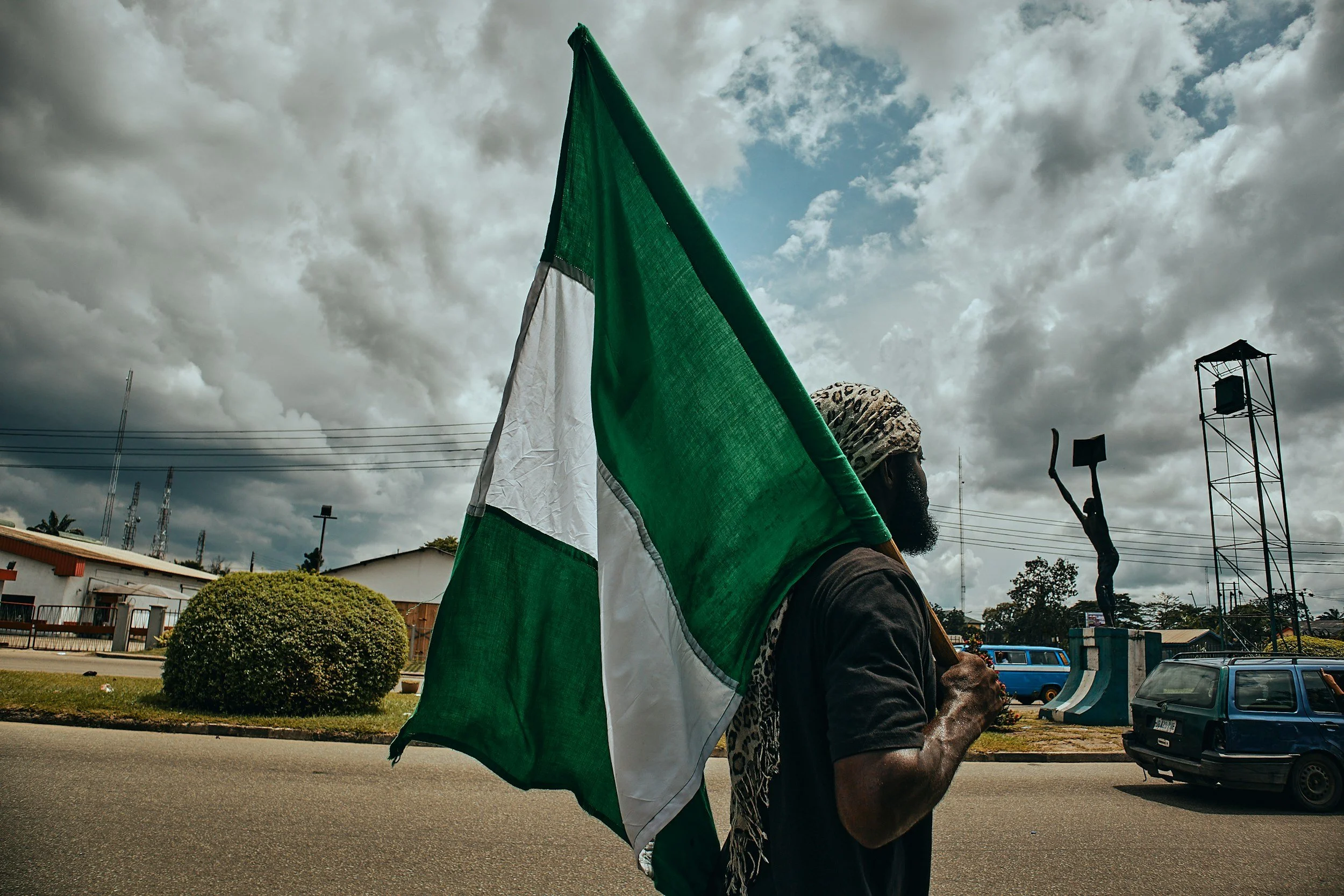
A man carrying the Nigerian flag. Photo: Emmanuel Ikwuegbu @emmages
At this point, it hardly feels like a question. Calamities are mounting week after week in Nigeria. The West African giant is experiencing one of its darkest periods of insecurity in recent history.
Calamities are mounting week after week, mass kidnappings, church attacks, the assassination of senior military officers, yet the national response has been slow, quiet, and disturbingly understated. Nigerians are left wondering: what is the President saying? What are state governors and security operatives doing? Where is the leadership, the urgency, and the decisive action that the moment demands?
On Monday, November 17, 2025, armed ‘bandits’ stormed the Government Girls Comprehensive Senior Secondary School (GGCSS) in Maga, in the Danko/Wasagu Local Government Area of Kebbi State a state in in North Eastern Nigeria. About 25 schoolgirls were abducted and the vice-principal, Malam Hassan Yakubu Makuku, was shot dead while trying to protect his students.
Security forces say a joint rescue operation involving the military, police, and local vigilantes is underway, combing forests and escape routes. But the horror remains: this is yet another Chibok-style tragedy. Another group of young girls torn from their classrooms, families plunged into fear, and a violent reminder that schools, the very places where the future of a nation is trained and shaped, are no longer safe. This is not just another abduction, it is a reminder of Chibok,. How many more “Chiboks” will Nigeria suffer before something truly shifts? The world is watchingg how very little has changed in Nigeria.
“Nigerians are not just grieving; they are tired of mourning without seeing change.”
A day after this incident, worshippers at a Christ Apostolic Church in the Eruku community of Kwara State - Central Nigeria - experienced a nightmare in real time on Tuesday evening, . Gunmen opened fire during a service that was being live-streamed online. Viewers across Nigeria watched in horror as shots rang out, people tried to hide behind the altar, attackers rounded up bodies, valuables. Several worshippers were shot, at least three people died, while others, including the pastor, were abducted.
One particular scene that was the most heartbreaking was when an old woman who could barely walk tried to hide behind the altar, it sparked an outrage and outcry that someone’s mother, grandmother or even a great grandmother was struggling for safety in the Church. How is one to process this thought? It raises the question of where can Nigerians actually feel secure, if even a house of worship - a space for peace, prayer, and refuge is now threatened.
The insecurity is not limited to civilians. Nigeria’s military forces have also suffered a devastating blow with the killing of Brigadier-General M. Uba at the hands of ISWAP militants. Reports suggest that his location may have been compromised shortly after a joint air and ground operation. His capture and execution by terrorists show that even high-ranking officers are not shielded from the worsening security breakdown. It’s also shows that a breached military has severe implications for national stability.
Weeks prior to these incidents U.S. President Donald Trump issued strong and controversial statements, claiming that Christianity in Nigeria is facing an “existential threat.” He accused “radical Islamists” of killing Christians and said he had instructed the U.S. Department of Defense to prepare for possible action should Nigeria fail to protect its citizens. He went as far as threatening military intervention and the suspension of U.S. aid, declaring on Truth Social that the U.S. may have to go into Nigeria “guns-a-blazing” if the situation continues.
Investigative journalist Jude Bela explains the complex factors behind Nigeria’s security challenges
The Nigerian government pushed back, insisting that Nigeria is not a nation divided by religion and that the portrayal of genocidal targeting of Christians does not reflect the country’s complex reality. Many analysts have echoed this, arguing that while Christians have undoubtedly suffered violence as have Muslims, the core drivers of instability in this case include terrorism, banditry, poverty, corruption, weak intelligence, and community conflicts, environmental changes; not a single religious agenda. Still, the very fact that a foreign leader is threatening intervention over Nigeria’s internal security crisis shows how badly the situation has deteriorated and how visible the failures of state response have become on the global stage.
Even American rapper Nicki Minaj raised global attention to the Christian persecution in Nigeria, calling for urgent international action during a U.S Mission to the United Nations event hosted by United States Ambassador to Nigeria, Mike Waltz, on Tuesday, she stated that In Nigeria, Christians are being targeted, driven from their homes and killed. Churches have been burned, families have been torn apart and entire communities live in fear constantly simply because of how they pray, stressing that the crisis demands urgent action.She insisted her position was not political or divisive. “I want to be clear, protecting Christians in Nigeria is not about taking sides or dividing people. It is about uniting humanity.”
So where does this leave Nigerians? Schools are no longer secure. Places of worship are coming under fire. Senior military officers are being hunted. Families are burying their loved ones while whole communities remain paralyzed by fear. Farmers have abandoned their farmlands. Yet policies remain slow, government statements vague, full of sympathy with concrete action limited. Nigerians are not just grieving; they are tired of mourning without seeing change.
This is why asking whether a state of emergency should be declared is not enough. One could argue that it should already have been declared. The country is facing a coordinated and escalating threat that demands more than routine security deployments or press statements. A nationwide emergency would only matter, however, if it comes with real reforms: stronger intelligence systems, better coordination, genuine investment in community security, and full transparency and accountability in how power and resources are used.
If not, a state of emergency risks becoming another symbolic gesture with no lasting impact. But without decisive action soon, Nigeria risks more kidnappings, more church and mosque massacres, more military losses and possibly even the loss of control over its own security narrative; as foreign actors begin shaping the global response.
The question, therefore, is no longer “should” a state of emergency be declared but why it has not been declared already.