Should a state of emergency be declared in Nigeria?
At this point, it hardly feels like a question. Calamities are mounting week after week in Nigeria. The West African giant is experiencing one of its darkest periods of insecurity in recent history.
By melody-Esther soyemi - Africa-Related, Nigeria
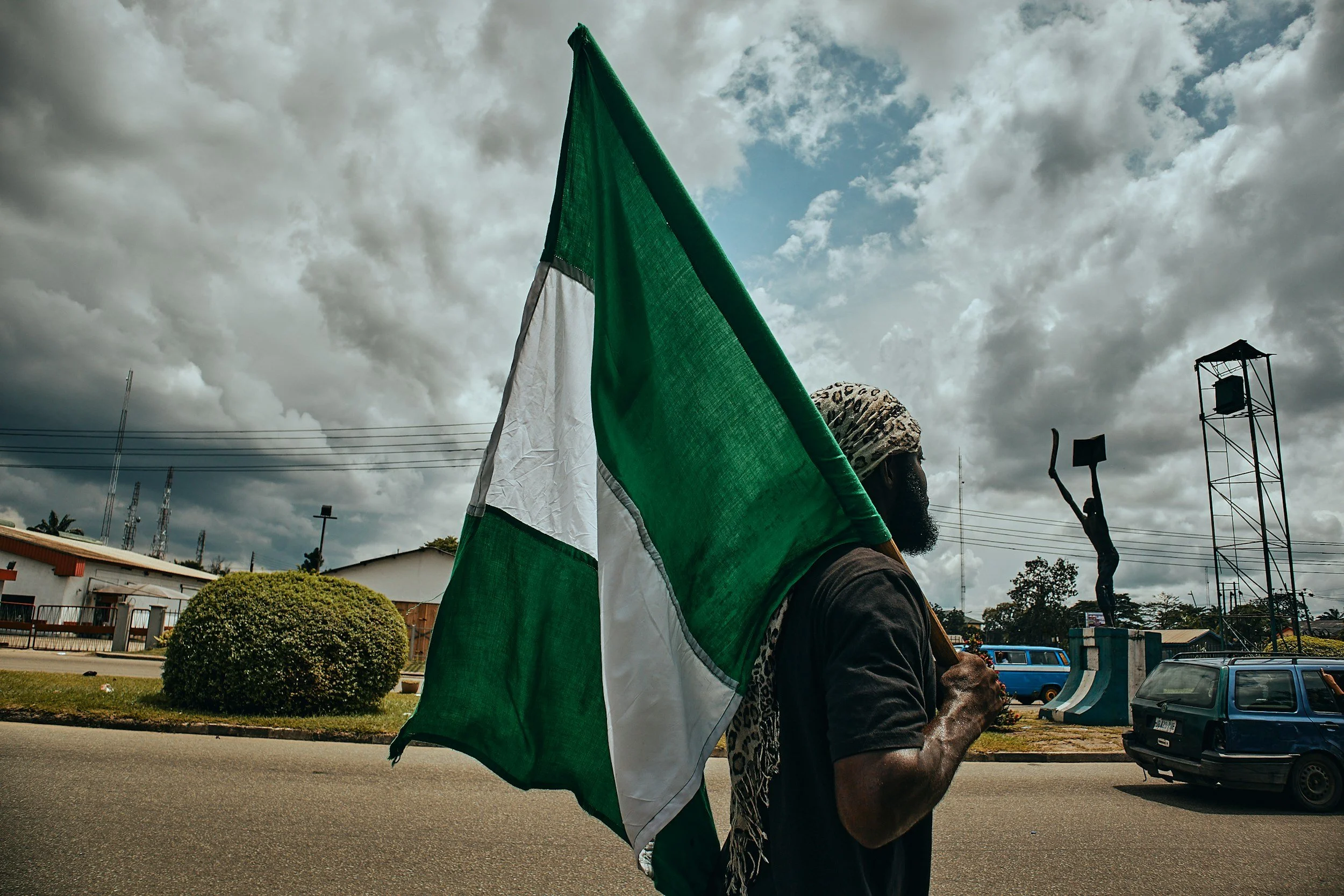
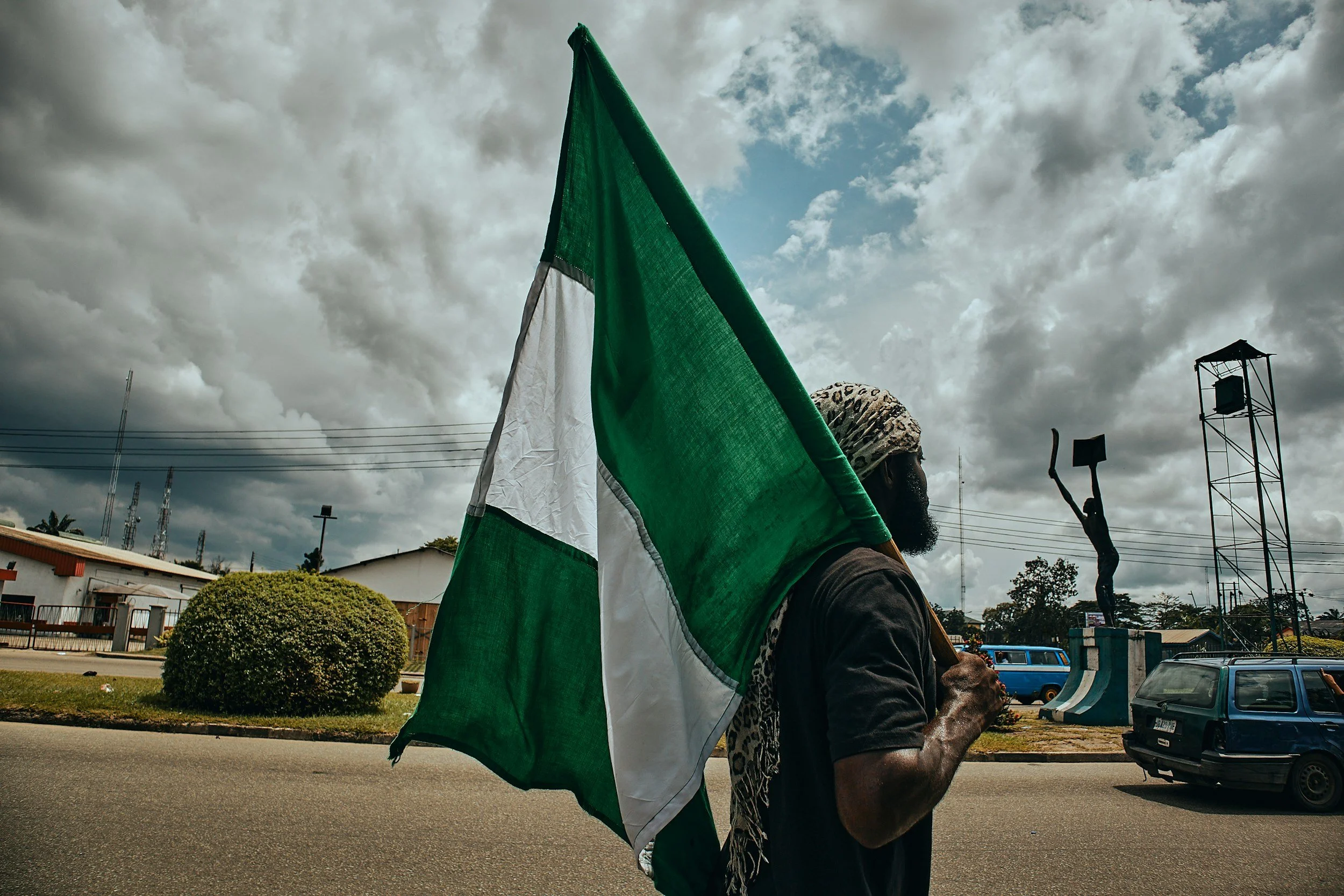
A man carrying the Nigerian flag. Photo: Emmanuel Ikwuegbu @emmages
At this point, it hardly feels like a question. Calamities are mounting week after week in Nigeria. The West African giant is experiencing one of its darkest periods of insecurity in recent history.
Calamities are mounting week after week, mass kidnappings, church attacks, the assassination of senior military officers, yet the national response has been slow, quiet, and disturbingly understated. Nigerians are left wondering: what is the President saying? What are state governors and security operatives doing? Where is the leadership, the urgency, and the decisive action that the moment demands?
On Monday, November 17, 2025, armed ‘bandits’ stormed the Government Girls Comprehensive Senior Secondary School (GGCSS) in Maga, in the Danko/Wasagu Local Government Area of Kebbi State a state in in North Eastern Nigeria. About 25 schoolgirls were abducted and the vice-principal, Malam Hassan Yakubu Makuku, was shot dead while trying to protect his students.
Security forces say a joint rescue operation involving the military, police, and local vigilantes is underway, combing forests and escape routes. But the horror remains: this is yet another Chibok-style tragedy. Another group of young girls torn from their classrooms, families plunged into fear, and a violent reminder that schools, the very places where the future of a nation is trained and shaped, are no longer safe. This is not just another abduction, it is a reminder of Chibok,. How many more “Chiboks” will Nigeria suffer before something truly shifts? The world is watchingg how very little has changed in Nigeria.
“Nigerians are not just grieving; they are tired of mourning without seeing change.”
A day after this incident, worshippers at a Christ Apostolic Church in the Eruku community of Kwara State - Central Nigeria - experienced a nightmare in real time on Tuesday evening, . Gunmen opened fire during a service that was being live-streamed online. Viewers across Nigeria watched in horror as shots rang out, people tried to hide behind the altar, attackers rounded up bodies, valuables. Several worshippers were shot, at least three people died, while others, including the pastor, were abducted.
One particular scene that was the most heartbreaking was when an old woman who could barely walk tried to hide behind the altar, it sparked an outrage and outcry that someone’s mother, grandmother or even a great grandmother was struggling for safety in the Church. How is one to process this thought? It raises the question of where can Nigerians actually feel secure, if even a house of worship - a space for peace, prayer, and refuge is now threatened.
The insecurity is not limited to civilians. Nigeria’s military forces have also suffered a devastating blow with the killing of Brigadier-General M. Uba at the hands of ISWAP militants. Reports suggest that his location may have been compromised shortly after a joint air and ground operation. His capture and execution by terrorists show that even high-ranking officers are not shielded from the worsening security breakdown. It’s also shows that a breached military has severe implications for national stability.
Weeks prior to these incidents U.S. President Donald Trump issued strong and controversial statements, claiming that Christianity in Nigeria is facing an “existential threat.” He accused “radical Islamists” of killing Christians and said he had instructed the U.S. Department of Defense to prepare for possible action should Nigeria fail to protect its citizens. He went as far as threatening military intervention and the suspension of U.S. aid, declaring on Truth Social that the U.S. may have to go into Nigeria “guns-a-blazing” if the situation continues.
Investigative journalist Jude Bela explains the complex factors behind Nigeria’s security challenges
The Nigerian government pushed back, insisting that Nigeria is not a nation divided by religion and that the portrayal of genocidal targeting of Christians does not reflect the country’s complex reality. Many analysts have echoed this, arguing that while Christians have undoubtedly suffered violence as have Muslims, the core drivers of instability in this case include terrorism, banditry, poverty, corruption, weak intelligence, and community conflicts, environmental changes; not a single religious agenda. Still, the very fact that a foreign leader is threatening intervention over Nigeria’s internal security crisis shows how badly the situation has deteriorated and how visible the failures of state response have become on the global stage.
Even American rapper Nicki Minaj raised global attention to the Christian persecution in Nigeria, calling for urgent international action during a U.S Mission to the United Nations event hosted by United States Ambassador to Nigeria, Mike Waltz, on Tuesday, she stated that In Nigeria, Christians are being targeted, driven from their homes and killed. Churches have been burned, families have been torn apart and entire communities live in fear constantly simply because of how they pray, stressing that the crisis demands urgent action.She insisted her position was not political or divisive. “I want to be clear, protecting Christians in Nigeria is not about taking sides or dividing people. It is about uniting humanity.”
So where does this leave Nigerians? Schools are no longer secure. Places of worship are coming under fire. Senior military officers are being hunted. Families are burying their loved ones while whole communities remain paralyzed by fear. Farmers have abandoned their farmlands. Yet policies remain slow, government statements vague, full of sympathy with concrete action limited. Nigerians are not just grieving; they are tired of mourning without seeing change.
This is why asking whether a state of emergency should be declared is not enough. One could argue that it should already have been declared. The country is facing a coordinated and escalating threat that demands more than routine security deployments or press statements. A nationwide emergency would only matter, however, if it comes with real reforms: stronger intelligence systems, better coordination, genuine investment in community security, and full transparency and accountability in how power and resources are used.
If not, a state of emergency risks becoming another symbolic gesture with no lasting impact. But without decisive action soon, Nigeria risks more kidnappings, more church and mosque massacres, more military losses and possibly even the loss of control over its own security narrative; as foreign actors begin shaping the global response.
The question, therefore, is no longer “should” a state of emergency be declared but why it has not been declared already.
share this story
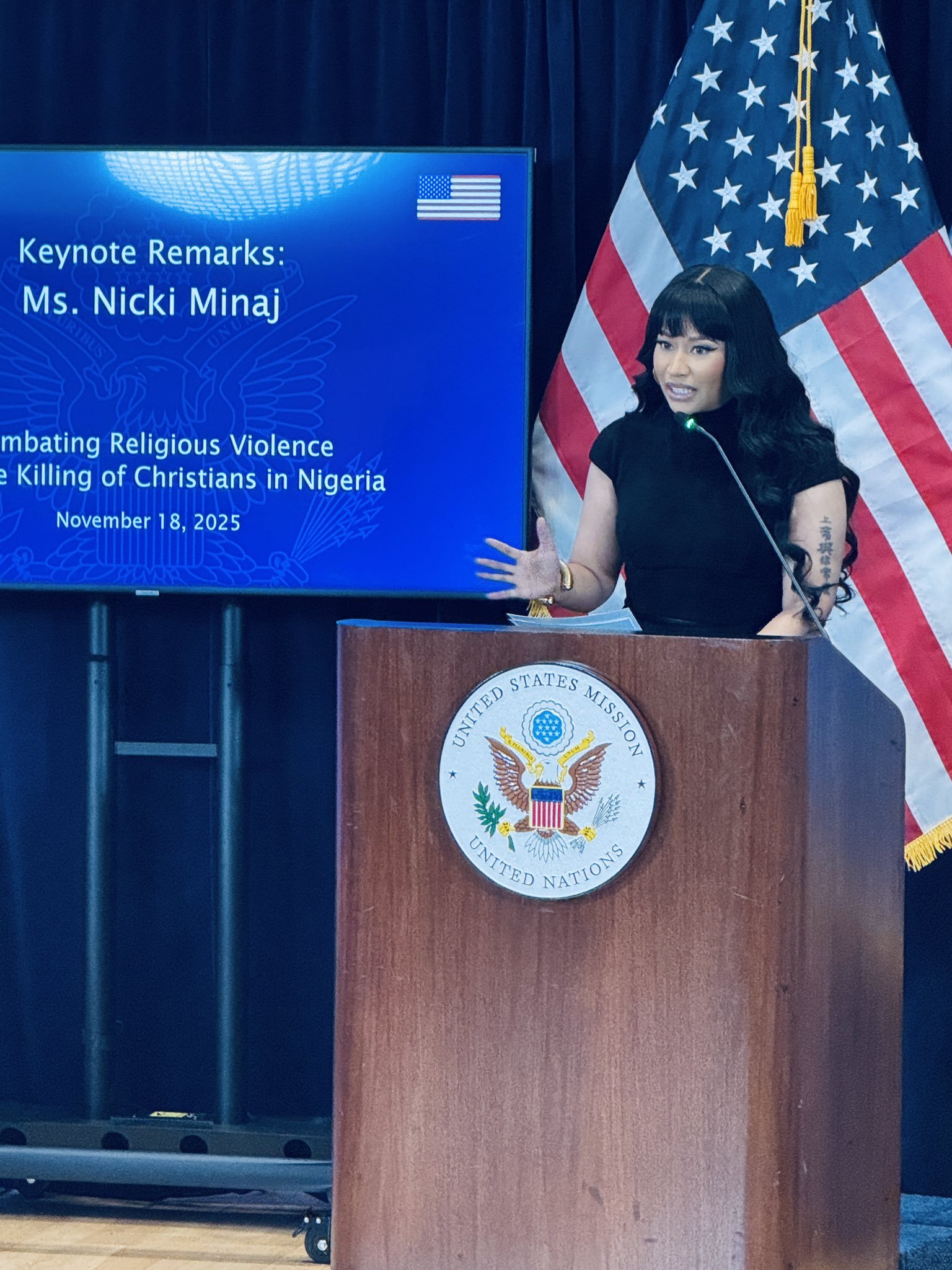
Nicki Minaj Speaks on Persecution of Christians in Nigeria
Nicki Minaj Speaks on Persecution of Christians in Nigeria
By Africa-Related, New York
"I would like to thank @POTUS for prioritizing this issue and for his leadership on the global stage in calling for urgent action to defend Christians in Nigeria." - @NICKIMINAJpic.twitter.com/gi8bLtF1Qt — @USUN November 18, 2025
TOPIC: Persecution of Christians in Nigeria
BRIEFER: U.S. Ambassador to the UN Mike Waltz
WHEN: Tuesday, November 18; 3:00 p.m. ET
BACKGROUND: On Tuesday, November 18, Ambassador Mike Waltz, U.S. Representative to the United Nations, hosted an event alongside grammy-winning rapper Ms. Nicki Minaj, faith leaders, and other prominent figures to address the critical issue of protecting religious freedom and the rising violence against Christians, particularly in Nigeria.
The event was live-streamed, and the link shared through USUN's X account: https://x.com/USUN?lang=en
Remarks at a U.S. Hosted Event on “Combatting Religious Violence and the Killing of Christians in Nigeria”
United States Mission to the United Nations
November 18, 2025
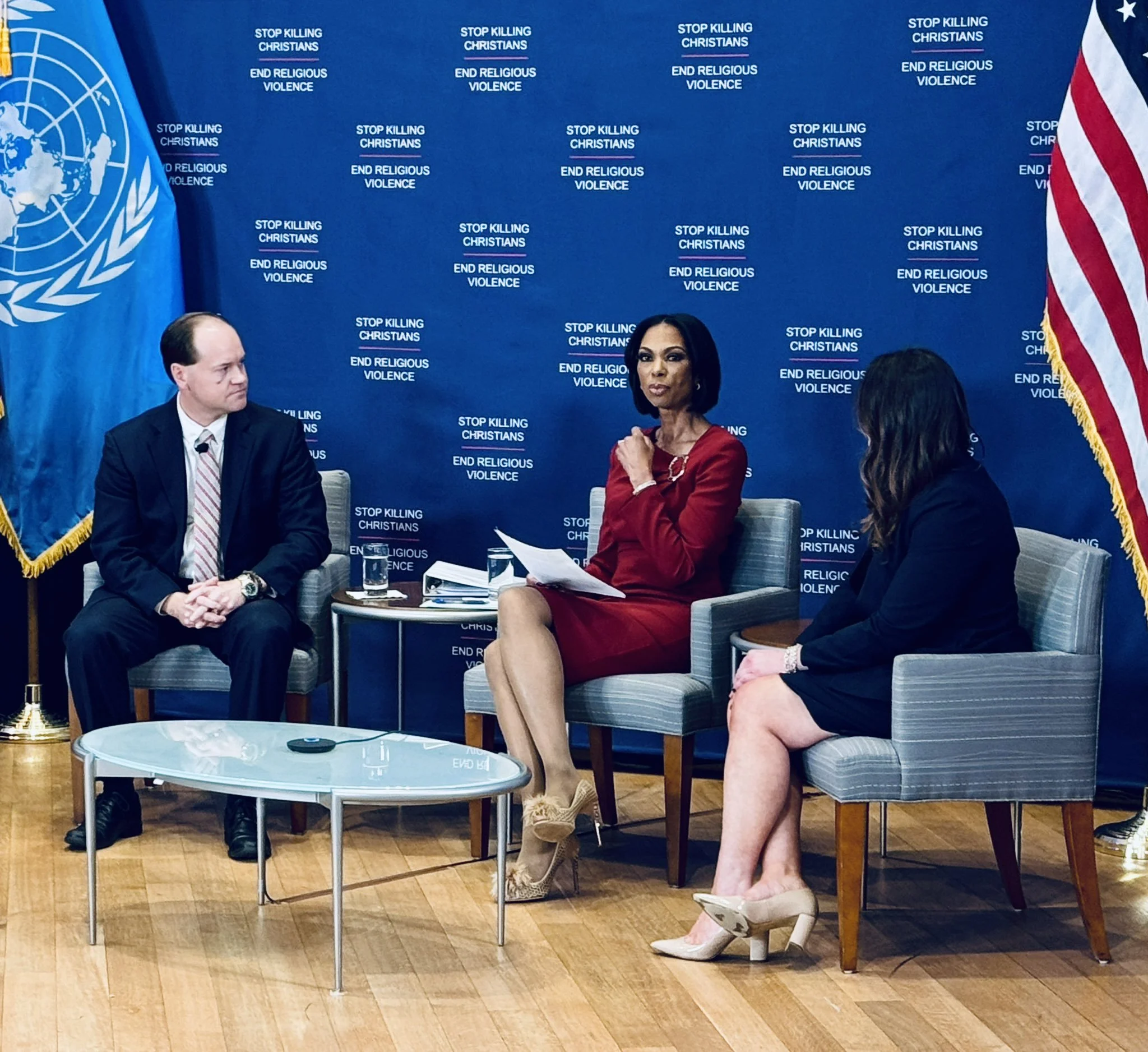
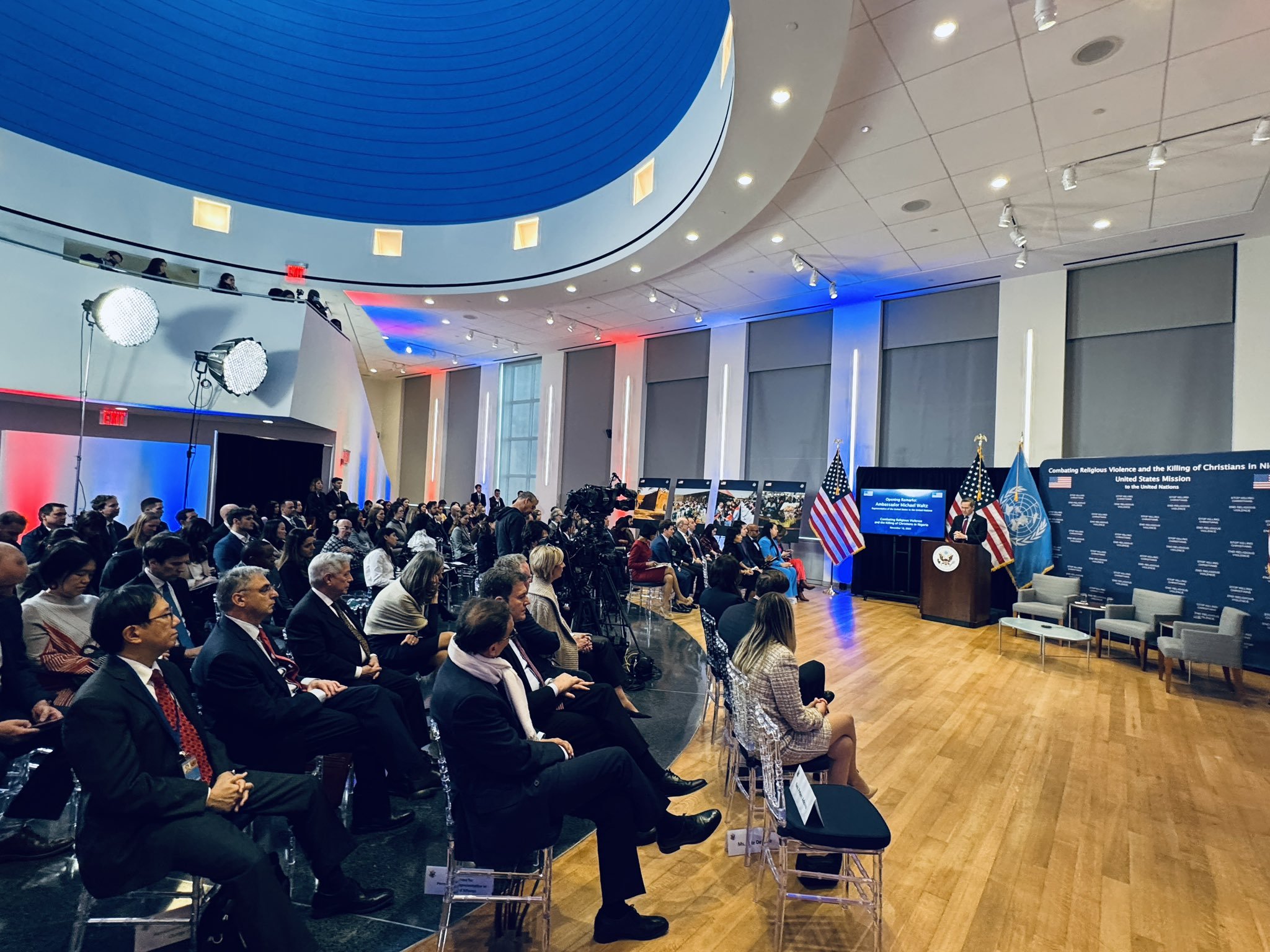
AMBASSADOR MIKE WALTZ: Oh my goodness. Thank you so much for everyone who has joined us today. And for a number of our ambassadors and delegates who have joined us, thank you for coming. To our faith leaders, survivors of some of these atrocities, and what I would call everyone here a friend of freedom, welcome to the United States Mission to the United Nations.
And today we speak of blood. We speak of the blood that still cries from Nigerian soil. This is deeply personal for me, as I know it is for Ms. Minaj and her pastor here, Peters Adonu, and others. I had the opportunity to serve in Nigeria in 2015, if you remember when then 300 little girls were kidnapped from their schools, ripped out of their homes and schools in the middle of the day, and in the middle of the night.
We sent a small team over there, and we trained – Nigeria’s equivalent of their Navy SEALs – to go get those girls back. It was righteous work. We didn’t get them all back, unfortunately, but we got some. Some will be lost forever. And if you remember the infamous save the girls campaign, that was 10 years ago. Folks, it’s still happening. It just happened yesterday. 25 little girls were ripped out of their school. I pray that we get them back. But what often happens is they’re sold into sex slavery. They’re forced to renounce their religion. They never see their homes or families again, and they literally disappear to the dark underbelly of extremism and sex slavery.
Look, 10 years later, the horror continues in the middle belt and in the north. Churches burn mothers, bury their children for the crime of singing Amazing Grace. Pastors have been beheaded. Pastors have been beheaded for preaching the Sermon on the Mountain, entire villages wake up to gunfire, because they dare to commit the crime, the crime of calling Jesus their Lord. People go to jail under blasphemy laws for simply wearing a cross. This is not random violence. This is genocide, wearing the mask of chaos.
Nigeria is Africa’s most populous nation and a vibrant mosaic of cultures and faiths, but it is under siege. And in the northern region, you have 12 Muslim majority states that are enforcing Sharia law and have enforced it since 1999. Jihadi groups like Boko Haram and the Fulani militias continue to unleash targeted violence. It is targeted. It is specific, on these Christian communities.
This year alone, the NGO, the nonprofit Open Doors, reports a very sharp rise in attacks. They’re reporting 80%, 80% of the violence against Christians worldwide is occurring in Nigeria. Thousands are displaced, are killed in faith based reprisals.
So weeks ago, a few weeks ago, the United States designated Nigeria a Country of Particular Concern for severe violations of religious freedom, spotlighting what can only be described as the government’s failure to curb these atrocities. And while Nigerian officials maintain that terrorism strikes all faiths indiscriminately, and they do. There is a body of evidence, and you are going to hear that from our experts today that paints a very grim picture of disproportionate suffering among Christians, where, again, families are torn apart. Clergy is repeatedly assassinated in entire congregations. Church congregations – you’re seeing, you see some of the images here – are driven into hiding.
Folks, we have an entire faith that is being erased, one bullet at a time, one torched Bible at a time. Yet, in the face of this evil one leader has refused to look away. President Trump has made the persecuted church his priority like no other president before him in American history. He was the first U.S. president to convene world leaders right here at the United Nations in 2019 to draw attention, draw the world’s attention to what is happening. He created the Religious Liberty Commission to fight for believers everywhere. And while Nigeria’s Christians cried out. He answered, and he has answered loudly. He has reminded the world that protecting Christians is not about politics. It is a moral duty.
So inspiration alone is not enough. We need voices that pierce the silence that we’ve heard from the international community, that humanizes the statistics that we keep hearing, and that demands accountability, and that’s why we’re here today to hear from a pastor that will dial in through our embassy in Nigeria, and we’re going to hear his first hand accounts of the suffering. We’re also going to hear from experts who have dedicated their lives to religious liberty.
I especially want to thank my friend Harris Faulkner, who, in addition to just being an amazing person, is also the daughter of a U.S. Army Colonel – so that makes her extra special in my heart – and she has spent much of her career protecting this most basic – folks this is the most basic of liberties: to worship as one sees fit.
But we are especially thrilled that we’re going to hear from an especially powerful voice, a fearless advocate whose passion for justice transcends borders, and she uses her voice to defend the voiceless. Hers are not empty words. They are a clarion call echoing the UN’s, the United Nations own Universal Declaration of Human Rights, which proclaims that, quote, everyone has the right to freedom of thought, to freedom of conscience and to freedom of religion. She steps onto this world stage, not as a celebrity, but as a witness. She uses and has used her influence to spotlight Nigeria’s persecuted church, reaching out to her 28 million followers, her Barbz, as I now have learned, and she uses this, and as she steps on this global stage to fund emergency relief and to demand action.
Nicki, I can’t tell you how much I admire you. You’re stepping up, you’re leaning into this issue. You’ve enjoyed amazing success, and you could be sitting back and just enjoying it. You could be just living the good life, but you’re willing to come here today and roll up your sleeves and let’s try to solve this. Let’s try to save these people. So everyone, please join me in welcoming a daughter of the Caribbean, a champion of the oppressed and a sister in Christ Nicki, Minaj.
###
MS. NICKI MINAJ: Hello everyone. I must say, I am very nervous, so please – Well, thank you, Ambassador Waltz for this invitation. It is an honor to stand on this stage with you and the other distinguished speakers here today to shine a spotlight on the deadly threat faced by thousands of Christians in Nigeria.
I would like to thank President Trump for prioritizing this issue and for his leadership on the global stage and calling for urgent action to defend Christians in Nigeria to combat extremism and to bring a stop to violence against those who simply want to exercise their natural right to freedom of religion or belief.
I stand here as a proud New Yorker with a deep sense of gratitude that we live in a country where we can freely and safely worship God, regardless of one’s creed, background, or politic. No group should ever be persecuted for practicing their religion, like I recently stated on social media, and we don’t have to share the same beliefs in order for us to respect each other. We’re way beyond thinking or expecting or assuming for you know, the person sitting next to you to have the exact same beliefs. We’re beyond that. That’s ridiculous, but that shouldn’t make one person feel less safe than anyone in any room.
Music has taken me around the globe. I have seen how people, no matter their language, culture, or religion, come alive when they hear a song that touches their soul. Religious Freedom means we all can sing our faith, regardless of who we are, where we live, and what we believe.
But today, faith is under attack in way too many places. In Nigeria, Christians are being targeted, driven from their homes and killed. Churches have been burned, families have been torn apart, and entire communities live in fear constantly, simply because of how they pray.
Sadly, this problem is not only a growing problem in Nigeria, but also in so many other countries across the world, and it demands urgent action. And I want to be clear, protecting Christians in Nigeria is not about taking sides or dividing people. It is about uniting humanity.
Nigeria is a beautiful nation with deep faith traditions and lots of beautiful Barbz that I can’t wait to see. When one’s church, mosque, or place of worship is destroyed. Everyone’s heart should break just a little bit, and the foundation of the United Nations, with its core mandate to ensure peace and security, should shake.
I am joined here today by peace builders, by faith leaders, by those who saw violence, saw rising intolerance, saw the threats clearly before us, and chose not to look the other way. I am inspired by their work to build interfaith ties, to see the humanity across the lines which might divide us, and to fight for security and liberty for all those who pray.
I look forward to our discussion today, and I hope it will encourage deepened solidarity for us to urgently work together to ensure every person can enjoy the right to believe, to worship, and to live in peace.
Barbz, I know you’re somewhere listening. I love you so very much. You have been the ultimate light in my life and career for so long. I appreciate you, and I want to make it very clear once again, that this isn’t about taking sides. This is about standing up in the face of injustice. It’s about what I’ve always done for my entire career, and I will continue to stand for that for the rest of my life. I will care if anyone anywhere is being persecuted for their beliefs.
Thank you.
###
share this story

KIDNAPPED In NIGERIA
A mother’s heart-wrenching story powerfully demonstrates why nowhere in Nigeria is truly safe from the pervasive menace of kidnappers and criminal gangs, least of all the nation’s capital, Abuja. This unfortunate reality underscores the growing fears and concerns among Nigerians, as they grapple with the constant threat that looms over their daily lives.
by oyiza adaba, New york
A SPECIAL REPORT
Deborah Sanni (RIP) was last seen in Area 1 on March 3, 2024. (Photo: Sanni Family)
On March 3, 2024, 29-year old Deborah Sanni, an Area 1 resident of Abuja, stepped out of their family home around 8:00 PM to pick some supplies from a nearby shop. Then the unthinkable happened.
"Every day I wake up with her thoughts on my mind. I sleep with her thoughts on my mind, because it's just like a dream - a nightmare." - Mrs. Matilda. Sanni
Her grieving, yet strong mother, Mrs. Matilda Sanni recalls the heart-wrenching incident, which powerfully explains why nowhere in Nigeria is truly safe from kidnappers - least of all the nation’s capital, Abuja. This unfortunate reality reflects the growing fears and concerns among Nigerians, as they grapple with the constant threat that looms over their daily lives.
In Deborah Sanni's case, her family paid a ransom on the same night, which her captors withdrew before dawn on March 4, 2024. Then they went silent. After a difficult week of searching, her family learned that her body had been found a week earlier and sent to a mortuary in another part of Abuja. This raises concerns about communication between the Nigerian Police, other security agencies, and hospitals.
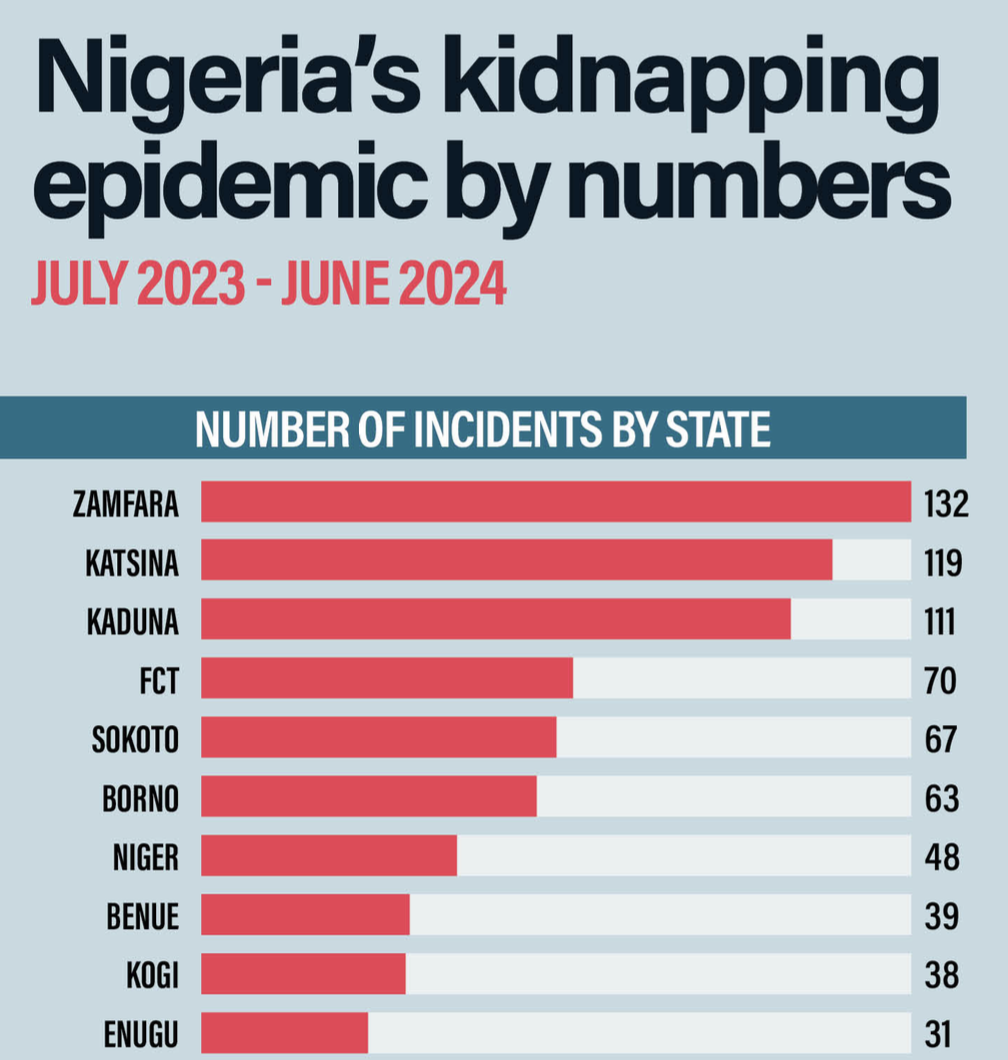
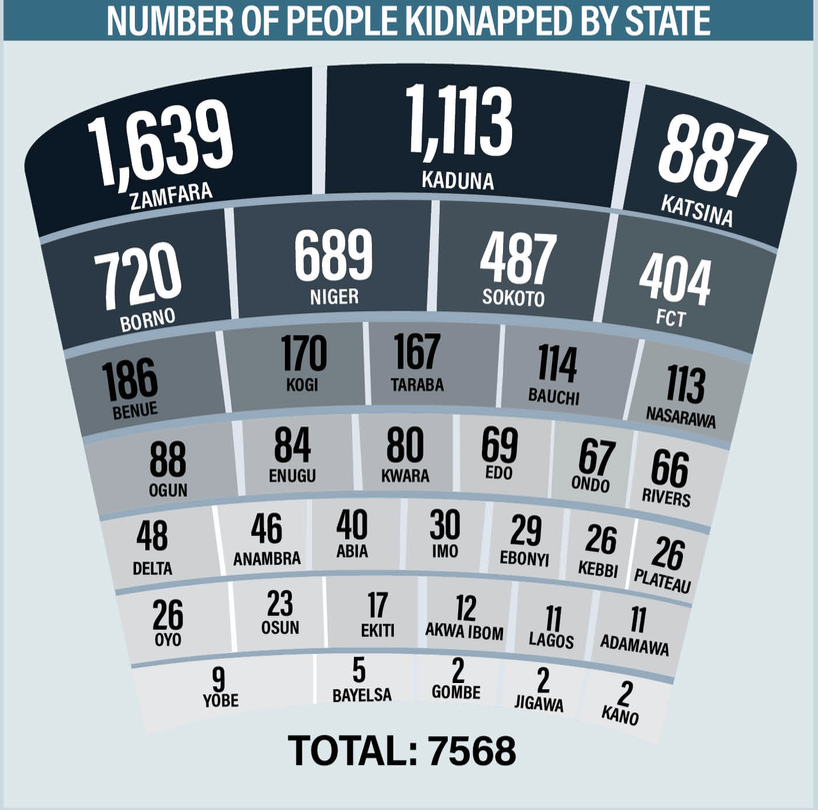
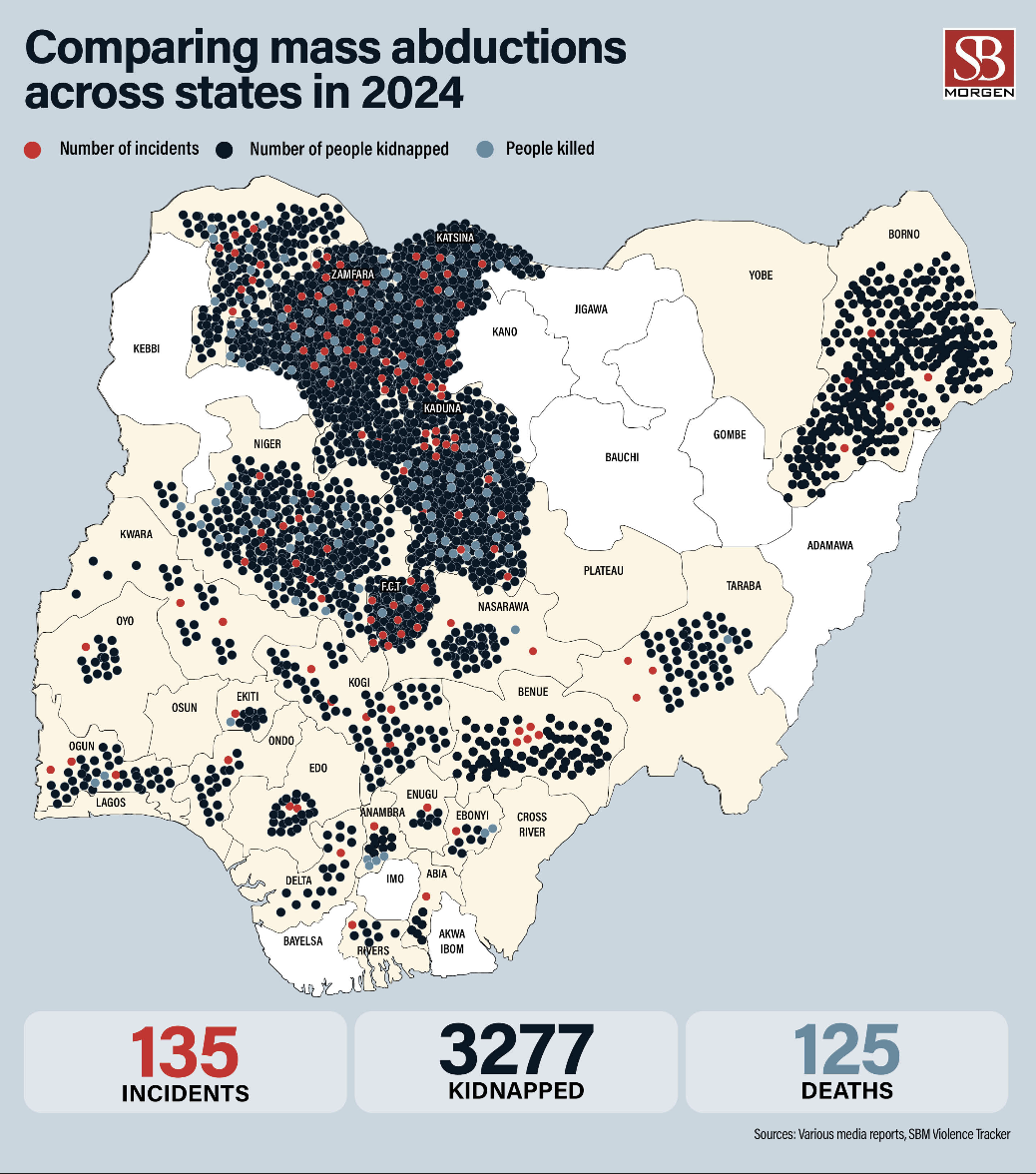
As we close out our year in 2024, we take a moment to remember all the victims of kidnapping in Nigeria, along with their families who continue to suffer. It is a sobering experience to review these statistics that reflect the plight of individuals who, tragically, will not be spending the upcoming year with their loved ones. The emotional toll this takes on families and communities is profound and deserves our attention and compassion.
SBM IntelLIGENCE 2024 Report
Nigeria’s security crisis has become increasingly complex, with armed groups and non-state actors exploiting the state’s weakened influence. This includes Boko Haram’s resurgence in the Northeast, armed gangs in the Northcentral and Northwest, secessionist violence in the Southeast, and gang-related issues in the Southwest. Amid these diverse security threats, widespread kidnap for ransom has emerged as a common thread.
Grim Reaping: Economics of Nigeria’s Kidnap Industry – A 2024 Update
- SBM INTELLIGENCE -
kidnapping statistics: SBM Intel 2024 Report